• Graphics
  • Figma
  • Research
  • Newsletter
  • About
  • Contact

Zhenia Vasiliev

  • Graphics
  • Figma
  • Research
  • Newsletter
  • About
  • Contact

Why Elon Musk’s Neuralink isn't as bad as you think

Figure 1. Neuralink: undergoing brain surgery for every upgrade is going to be slightly trickier than getting a new model of iPhone

Think of the computer sitting on your desk in front of you. You fire it up, you launch your email software, you use its interface to create an email to your boss saying you’re at home sick. Well, you’re not at home sick, in fact, but sipping your bubble tea in a nearby cafe, busy catching up on your favourite tech blogs. Doesn’t matter. Yet think about the relationship you have with the machine at this moment. At every moment of sending that email you are perfectly aware who you are, and by looking at the computer interface you can tell whether the machine is receiving your cues when you type the text in. You can tell that you manifest your behaviour by clicking the “send” button on that email client, and that’s where your action ends, and machine action begins. In a way, there is a certain established pipeline of intention coming from your brain, to your physical movements that gets translated by the interface into the machine commands. These commands then convert into electrical signals, and so on, all the way to the electric signals generated by synapses in the brain of your boss. She’s inevitably getting upset to hear about you being sick and perhaps a little annoyed about the project deadline being missed today.
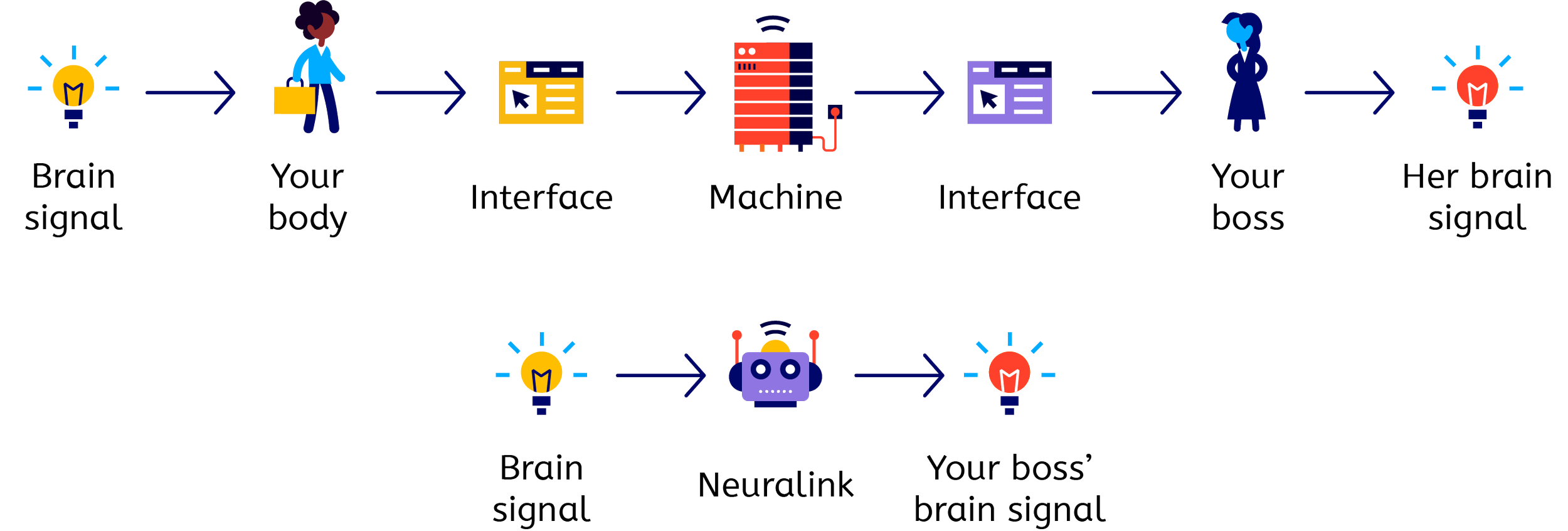
Figure 2. Intention pipeline

Now, welcome to the era of Neuralink. Founded in 2016, Neuralink is Musk's neural technology company tasked with conjuring up an implant designed to interface directly with the human brain. The initial goal of the implant, says Musk, is to use it as a means to treat brain injury and trauma (Business Insider). With one of those Neuralinks installed, you wouldn’t have to use your body parts to type anymore. Instead, the machine that has been surgically injected into your brain reads all your electrical signals directly. It then sends that email without you ever touching the keyboard - provided, of course, you can pronounce the words in your mind without spelling mistakes. However you look at such a human-machine interface, it comes out pretty scary, huh? Robots tinkering on the inside of your skull, you know… But let’s look more closely at the main criticisms of Neuralink to see if it’s really as bad as we’d usually imagine.

1. Psychological and physiological implications

In a well-weighted ethical critique of brain-machine interfaces (BMIs), Director of the Arizona State University Risk Innovation Lab Andrew Maynard points out a few important things to keep in mind. There are plenty of things that can go wrong when you use laser beams to melt a “neural lace” - a term, in fact, adopted from Iain M. Banks 1996 sci-fi piece, Excession, see the book excerpt in the blockquote - through the skull and into the brain. Yet despite the risks, for patients and their families these will be most likely outweighed by the tremendous benefit of being able to become a functional member of society again. Disabled people will be able to use their paralysed limbs, be able to see, hear - or perform any other essential functions.

“It was a little bundle of what looked like thin, glisteningly blue threads, lying in a shallow bowl; a net, like something you’d put on the end of a stick and go fishing for little fish in a stream. She tried to pick it up; it was impossibly slinky and the material slipped through her fingers like oil; the holes in the net were just too small to put a finger-tip through. Eventually she had to tip the bowl up and pour the blue mesh into her palm.”
— Iain M. Banks, Excession, 1996

2. Obsolesence

Now, that’s where the real trouble begins. A big real-world complication that Neuralink is facing even now, before its launch, is obsolescence. In 2019, Musk claimed that this year we will see first human patients - while in Joe Rogan podcast released this month, the deadline has moved to 2021. Technology moves rapidly, particularly around BMI, and seemingly banal questions like “how do we upgrade the hardware when the new version of software comes out?” can be a show stopper. New and more effective versions of software that we develop are going to require new hardware. Yet if we need to perform brain surgery on millions of people, who are inevitably ageing and whose health was not so good to begin with, it makes shipping of new software releases, reasonably, quite problematic. In other words, undergoing brain surgery is slightly trickier than getting a new iPhone. This could be one of the reasons why Musk is hesitant to implant the hardware in its current shape. Essentially, while the humankind struggles to come up with a USB port that is going to be one and for everybody and for all time, similar to the human ear or mouth, no effective BMI can be implemented as a long-term scenario.

“If we need to perform brain surgery on millions of people, who are inevitably ageing and whose health was not so good to begin with, it makes shipping of new software releases, reasonably, quite problematic.”

Speaking of software development, it should be noted that Neuralink is currently hiring software engineers, big time. If you’re full stack or interested in machine learning, you should probably apply. There has been a discussion on Reddit as to what are the potential programming languages, technology stacks, architectures that will be used for Neuralink apps. It is, it seems, essentially Webservices peppered with a great deal of Rails, React, Typescript and Postgres. At the bottom of the stack it most probably relies on languages with efficient signal-processing and machine learning capabilities, such as Python - see another related Reddit. The bottom line, whichever way the brain activity is translated into a control signal, it will be up to more conventional software implementation to process it.

“Neuralink apps are essentially Webservices peppered with a great deal of Rails, React, Typescript and Postgres. At the bottom of the stack it most probably relies on languages with efficient signal-processing and machine learning capabilities, such as Python”
— Reddit

3. There will be two classes of humans, one with AI-enhanced brains and the lower class

This is not likely to happen for two reasons. Firstly, we live in the knowledge economy, which makes profits on users’ data, and the aim of any new or existing business venture is mainly to collect the user data. Once the data is collected, the technological tools are then used to analyse and create business strategies based on that data. Quite logically, these new strategies are aimed at capturing even more data in the easier way. With this idea in mind, it wouldn’t surprise us if Neural Lace, once released, is going to hit the market running and will be offered cheaply to everybody. Even for those who completely struggle to buy it, there will be a monthly instalment plan and all sort of deals. After all, it’s just another tool of collecting user data, and it needs to be out there in order to generate any revenue.

The other reason why the new technologically-privileged class is not likely to appear is vagueness around the device’s security and ethics. What kind of privilege is that anyways, to be exposed to neural emotionally-enhanced ads that effectively turn you into a zombie, and use pretty much all of your brain’s contents for marketing and training purposes? Let alone forgetting to update the software and risk your brain being hacked into.

To sum up

With $100 million of investment from Musk himself and about a half less from other investors (businessinsider), it seems unlikely that the venture is going to make a cut any time soon. The idea of hard-wiring technological components to parts of the human body as sensitive as the brain is going to meet a lot of traction from both sides. Customers in the open market will be hesitant if they want to do a brain surgery every five years, which this device seemingly implies. Software application suppliers will feel constrainted by the inflexibility of platforms, essentially being stuck with the equivalent of producing programs for Internet Explorer 6. Or worse yet, risk having the same situation as the whole global banking system has these days, where the software is still using Cobol blueprints from the 1980s (OneZero). Whether Neuralink has answers to this or not, we will find out on August 28th when it’s due to report on its progress (techcrunch).

Do you think I’m wrong about anything here? I’m most certainly am - and will be happy to hear what you think. Leave a comment below (or in any social media where I’m posting this in).

READ MORE
When Women Were Software
September 28, 2020
When Women Were Software
September 28, 2020

A documentary titled The Computers: The Remarkable Story of the ENIAC Programmers, tells a story women who developed America’s first electronic computer to automate ballistic computations during World War II. In the film, the six programmers share their stories about their hard work alongside over two hundred other women, both civilian and military, who were doing the computations before the machine came to replace them. Why, despite the massive contribution, the programmers were not introduced to the public when ENIAC was released to the public in 1946? This week, I look at the historical paradox where women were celebrated during the war as breaking into the ”male” territories of science, technology and engineering, yet at the same time, no-one heard much about their contribution in the early days of computer science. Like to help this blog going? Tell your friends about it, like and share the post. Check out the full blog post here: https://bit.ly/XXXX

Read more →
September 28, 2020
How to escape the interview horror: talking good old expertise and teamwork
September 13, 2020
How to escape the interview horror: talking good old expertise and teamwork
September 13, 2020

It is as hard for the employer to find a developer, as it is for a developer to find a job. Yet, don’t worry about any other candidates they might be looking at, since most of them wouldn’t be able to program for their life. If you can successfully write a loop that goes from 1 to 10 in every language on your resume, can do simple arithmetic without a calculator, and can use recursion to solve a real problem, you're already ahead of the pack. This week, we talk about more curious things: the minds of people who interview you. What are they looking for, and how do they make sure what they find in you and other candidates is what they need? It comes down to two things - checking that you’re smart and get things done. That’s why any interview conversation usually breaks down into two themes - technical skill and teamwork. Like to help this blog going? Tell your friends about it, like and share the post. Check out the full blog post here:

Read more →
September 13, 2020
Will Open Source Actually Beat Silicon Valley Start-Ups?
September 6, 2020
Will Open Source Actually Beat Silicon Valley Start-Ups?
September 6, 2020

Essentially, there are two ways of producing software. One is the ”Silicon Valley” way, where you start up as an entrepreneur in your garage, reach out to venture capitalists (VCs) who then invest into your idea, and later scale, if you’re successful - like Facebook. The second is a community way, where numerous members inspect, modify and enhance the applications that have openly available code bases. They gradually improve and add on features as the project goes along, like Linux.

Read more →
September 6, 2020
How to get your first software developer job
August 29, 2020
How to get your first software developer job
August 29, 2020

You need to find a job to get software development experience, and you need the experience to find a job. A Catch 22? Well, not exactly. For one thing, development as a profession changes so much overtime that anyone who works here ends up learning, unlearning and re-learning things. And for another, coding culture differs from company to company, and it is going to take months for anyone, regardless of their experience to start knocking out valuable, production-ready code. This is why your chances of getting a job are not as bad as you might think. All you need to show them is that you have an open mind and easy to work with. As for specific skills, these will skyrocket once you’re positioned in a company where you’d be spending 8 hours a day coding, surrounded by experienced colleagues.

Read more →
August 29, 2020
Why you hate software engineer unions for all the wrong reasons
August 23, 2020
Why you hate software engineer unions for all the wrong reasons
August 23, 2020

Software development field looks like a level playing field for those who are starting out. There are many new exciting things to learn. Employers are readily lining up in front of your door with bright job offers. But one thing we learn soon is that the industry is regulated by the big business players. They are, alas, catering for their own needs rather than the worries of software engineers who do the work. This calls for a new set of regulations between programmers and those who hire them. You don’t have to call it a “union” if you hate associating yourself with the industrial workers, crowded outside of the factory walls. Today I look at why anyone can win from these regulations, including you. Ideas, thoughts or objections? Do you already have a tech union membership experiences? I’d like to hear your opinions - post a comment here, and please like and share this to keep the blog going.

Read more →
August 23, 2020
Top free task management apps software developers love to hate
August 16, 2020
Top free task management apps software developers love to hate
August 16, 2020

Working as software developers, we are torn between so many different options for productivity tools. Some of them come as a default option from work (that we hate), some we love to use for personal stuff. But the problem with using many different tools is that it’s too hard to keep track of so many things in so many different places. So the easy answer is, choose one (!) tool and stick to it. But which one to choose then? Here I look at four tools which are hot this year.

Read more →
August 16, 2020
All you need to survive your next React project
August 13, 2020
All you need to survive your next React project
August 13, 2020

It’s a bit annoying with searching the internet - every time you look for a framework or a library which is a little bit trendy, Google simply brings up posts by its advocates. They will tell you a lot of nice things about it. The same problem with React, a popular Javascript library - you will hardly learn what’s the problem with it, even if you enter “when not to use React” into the search engine. Yet, it’s simple, and written plainly in reactjs.org Design Principles: ”The key feature of React is composition of components. Components written by different people should work well together”. “Should”, right?

Read more →
August 13, 2020
How to become a software developer for free in 2020
August 4, 2020
How to become a software developer for free in 2020
August 4, 2020

The problem that many people encounter when they decide to switch to software development is that they unknowingly make things harder for themselves. They jump into too many frameworks or learn programming languages without any particular system, going into the dense stuff way too early. In this piece you’ll find how to approach the new discipline without getting completely demoralised.

Read more →
August 4, 2020
Why Elon Musk’s Neuralink isn't as bad as you think
July 28, 2020
Why Elon Musk’s Neuralink isn't as bad as you think
July 28, 2020

Think of the computer sitting on your desk in front of you. You fire it up, you launch your email software, you use its interface to create an email to your boss saying you’re at home sick. Well, you’re not at home sick, in fact, but sipping your bubble tea in a nearby cafe, busy catching up on your favourite tech blogs. Doesn’t matter. Yet think about the relationship you have with the machine at this moment. At every moment of sending that email you are perfectly aware who you are, and by looking at the computer interface you can tell whether the machine is receiving your cues when you type the text in. You can tell that you manifest your behaviour by clicking the “send” button on that email client, and that’s where your action ends, and machine action begins. In a way, there is a certain established pipeline of intention coming from your brain, to your physical movements that gets translated by the interface into the machine commands. These commands then convert into electrical signals, and so on, all the way to the electric signals generated by synapses in the brain of your boss. She’s inevitably getting upset to hear about you being sick and perhaps a little annoyed about the project deadline being missed today.

Read more →
July 28, 2020
How to invent software engineering
July 22, 2020
How to invent software engineering
July 22, 2020

Margaret Hamilton did not simply help put the man to the Moon. She had also invented the concept that would go along to create a major paradigm shift in ideas that people have about computers. She was the first person to make a difference between hardware and software. How do you come up with an idea of such scale and influence? - I was asking myself while watching through the video clip shared on Google’s blog a year ago. In the video, set in Mojave desert, California, we see a giant portrait of Hamilton. It is made out of mirrors that catch the moon light when darkness falls over the desert, illuminating all at once. The graphic qualities of the portrait aside, you can look at it and marvel at the tribute that earthlings pay to the legendary Apollo flight software designer, a team lead who made it possible to set human feet onto the Moon surface.

Read more →
July 22, 2020

Never miss a post

Sign up with your email address to receive news and updates.

We respect your privacy.

Thank you!
tags: digital illustration, software engineering, Elon Musk, interface, brain-machine, neuralink, AI
categories: today
Tuesday 07.28.20
Posted by Zhenia
Newer / Older

Zhenia Vasiliev © 2025