• Graphics
  • Figma
  • Research
  • Newsletter
  • About
  • Contact

Zhenia Vasiliev

  • Graphics
  • Figma
  • Research
  • Newsletter
  • About
  • Contact

Notes on Stuart Hall, Encoding, Decoding

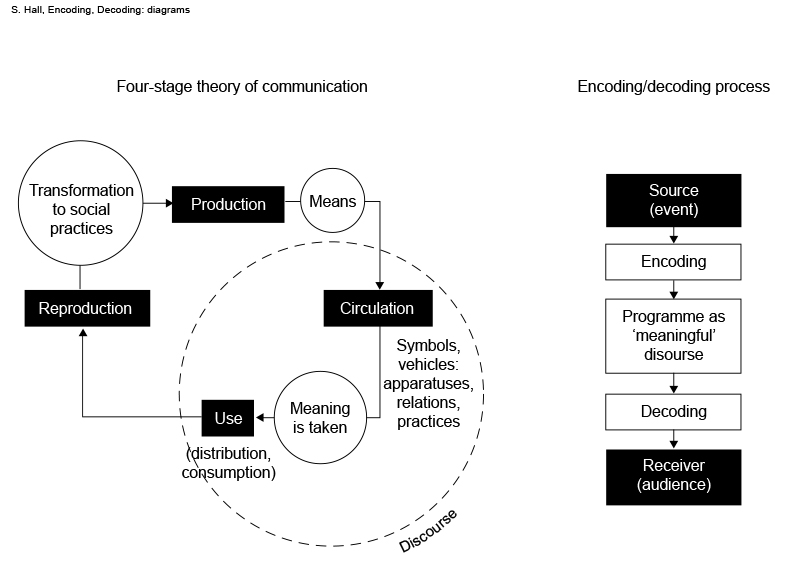
Four-stage theory of communication: production, circulation, use (distribution or consumption), reproduction

Polysemy - capacity for a sign (such as a word, phrase, or symbol) to have multiple meanings, usually relatedly contiguity of meaning within a semantic field.
Hall argues that polysemy is not the same as pluralism, as each stage limits the next one - they are ‘relatively autonomous’.
At each stage, messages are ‘imprinted’ by institutional power relations: communication circuit is also a circuit which reproduces a pattern of domination.

Process: a ‘complex structure of dominance’, sustained through the articulation of connected practices, each of which, however, retains its distinctiveness.

Object = operation of codes within a syntagmatic chain of discourse -> creates the apparatuses, relations and practices of production. Circulation of ‘product’ takes place in this discursive form. To complete the circle, the discourse must be transformed again into social practices. If no ‘meaning’ is taken, there can be no ‘consumption’.

“The event must become a ‘story’ before it can become a communicative event. And the moments of ‘encoding’ and ‘decoding’ are determinate moments”

Television message: is created in the production, which is itself a discourse, consisting of existing professional practices and relations. It is also open-ended system and draws from the wider socio-cultural and political structure (of which it is a differentiated part). Audience is both ‘source’ and ‘receiver’ (P. Elliot) - as circulation and reception are also moments of production in television message.

In order to have an ‘effect’, satisfy a ‘need’ or put to ‘use’ the message must be first appropriated as a meaningful discourse and be meaningfully decoded.

Meaning structures on the encoding stage may not be the same as on the decoding stage ( they do not constitute an ‘immediate identity’) -> this depends on the degrees of symmetry/assymetry between encoder-producer and decoder-receiver -> this depends on identity/non-identity between the codes. Misunderstandings arise from the lack of equivalence between the two sides in the communicative exchange.

Behaviorist approach is misleading. Violence on TV is ‘not violence but messages about violence’, but we’re still unable to comprehend this epistemological distinction.

TV sign = visual + aural discourses. But it cannot be referent or concept it signifies (as it is a translation of three-dimensional world into two-dimensional planes).
Discursive ‘knowledge’ is the articulation of language.

Certain widely distributed codes have been profoundly naturalised, and may appear not to be constructed. But even apparently ‘natural’ visual codes are culture-specific.

When de-coded, the codes frequently assume the status of naturalised perceptions (e.g. the icon for cow = the cow).
Eco: signs ‘look like objects in the real world because they reproduce the conditions [the codes] of perception in the viewer’.
Iconic sign is more vulnerable to being ‘read’ as natural because it has some of the properties of the thing represented (as opposed to linguistic sign, ‘cow’ which has none).

Linguistics: denotation (direct, natural) and connotation (associative meaning) - but for SH the distinction is an analytic one only, as in the actual discourse most signs will combine the two aspects. But such disctiction is still important as a means of analysis, because it is at the connotative level of the sign that situational ideologies alter and transform signification. That’s where the active interventions of ideologies are clearly seen - although that does not mean the denotation is ideology-free: it’s just the meaning that became fully ‘natural’. In this case ‘denotation’ and ‘connotation’ are not about presence or absence of ideology in language, but the different levels at which ideologies and discourses intersect.

Already coded signs intersect in the context, being positioned in a discursive field. E.g. a ’sweater’ may signify ‘cold weather’, ‘casual wear’ or ‘long autumn walk in the woods’, depending on the context. Every society/culture is classified into the ‘maps of meaning’ - ‘maps of social reality’.

RELATED
When Women Were Software
September 28, 2020
When Women Were Software
September 28, 2020

A documentary titled The Computers: The Remarkable Story of the ENIAC Programmers, tells a story women who developed America’s first electronic computer to automate ballistic computations during World War II. In the film, the six programmers share their stories about their hard work alongside over two hundred other women, both civilian and military, who were doing the computations before the machine came to replace them. Why, despite the massive contribution, the programmers were not introduced to the public when ENIAC was released to the public in 1946? This week, I look at the historical paradox where women were celebrated during the war as breaking into the ”male” territories of science, technology and engineering, yet at the same time, no-one heard much about their contribution in the early days of computer science. Like to help this blog going? Tell your friends about it, like and share the post. Check out the full blog post here: https://bit.ly/XXXX

Read more →
September 28, 2020

Although connotations are subject to transformations, this polysemy must not be confused with pluralism. Connotative codes are not equal - every culture/society imposes their own classifications (dominant cultural order). Meanings are organised hierarchically around dominant or preferred ones. ‘Dominant’ and not ‘determined’ - because it is always possible to decode, etc. event within more than one ‘mapping’. For this reason, also, the communicative process consists of performative rules - re-enforcing one semantic domain over the other, etc. - interpretative work.

Reading (Terni) - not only the capacity to identify/decode certain signs, but also subjective capacity to creatively relate them to one another.

Misunderstanding in the televisual communication - ideal is ‘perfectly transparent communication’ - the reality is ‘systematically distorted communication’. Critique of ’selective perception’ theory (as it is never as selective, random or privatised as the concept suggests).

Three hypothetical positions from which decodings of a televisual discourse may be constructed:
1. Dominant hegemonic position. Straightforward decoding of the news program by viewers means they are operating inside the dominant code. Broadcasting professionals are able to operate in two codes, their professional code (‘relatively autonomous’) and hegemonic signification of events.
Hegemonic viewpoint:
    1) Defines within its terms the mental horizon, the universe of possible meanings;
    2) Carries with it the stamp of legitimacy - coterminous with what is ‘natural’, ‘inevitable’ about the soil order.

2. Negotiated (corporate) code. Acknowledges the hegemonic viewpoint, but operates with exceptions to the rule. S.Hall suggests that that’s where the majority of misunderstandings come from.

3. Oppositional code. Decoding the message in a globally contrary way. Here the TV company comes to a crisis and where the ‘politics of signification’ - the struggle in discourse - is joined.

Never miss a post

Sign up with your email address to receive news and updates.

We respect your privacy.

Thank you!
READ MORE
When Women Were Software
September 28, 2020
When Women Were Software
September 28, 2020

A documentary titled The Computers: The Remarkable Story of the ENIAC Programmers, tells a story women who developed America’s first electronic computer to automate ballistic computations during World War II. In the film, the six programmers share their stories about their hard work alongside over two hundred other women, both civilian and military, who were doing the computations before the machine came to replace them. Why, despite the massive contribution, the programmers were not introduced to the public when ENIAC was released to the public in 1946? This week, I look at the historical paradox where women were celebrated during the war as breaking into the ”male” territories of science, technology and engineering, yet at the same time, no-one heard much about their contribution in the early days of computer science. Like to help this blog going? Tell your friends about it, like and share the post. Check out the full blog post here: https://bit.ly/XXXX

Read more →
September 28, 2020
How to escape the interview horror: talking good old expertise and teamwork
September 13, 2020
How to escape the interview horror: talking good old expertise and teamwork
September 13, 2020

It is as hard for the employer to find a developer, as it is for a developer to find a job. Yet, don’t worry about any other candidates they might be looking at, since most of them wouldn’t be able to program for their life. If you can successfully write a loop that goes from 1 to 10 in every language on your resume, can do simple arithmetic without a calculator, and can use recursion to solve a real problem, you're already ahead of the pack. This week, we talk about more curious things: the minds of people who interview you. What are they looking for, and how do they make sure what they find in you and other candidates is what they need? It comes down to two things - checking that you’re smart and get things done. That’s why any interview conversation usually breaks down into two themes - technical skill and teamwork. Like to help this blog going? Tell your friends about it, like and share the post. Check out the full blog post here:

Read more →
September 13, 2020
Will Open Source Actually Beat Silicon Valley Start-Ups?
September 6, 2020
Will Open Source Actually Beat Silicon Valley Start-Ups?
September 6, 2020

Essentially, there are two ways of producing software. One is the ”Silicon Valley” way, where you start up as an entrepreneur in your garage, reach out to venture capitalists (VCs) who then invest into your idea, and later scale, if you’re successful - like Facebook. The second is a community way, where numerous members inspect, modify and enhance the applications that have openly available code bases. They gradually improve and add on features as the project goes along, like Linux.

Read more →
September 6, 2020
How to get your first software developer job
August 29, 2020
How to get your first software developer job
August 29, 2020

You need to find a job to get software development experience, and you need the experience to find a job. A Catch 22? Well, not exactly. For one thing, development as a profession changes so much overtime that anyone who works here ends up learning, unlearning and re-learning things. And for another, coding culture differs from company to company, and it is going to take months for anyone, regardless of their experience to start knocking out valuable, production-ready code. This is why your chances of getting a job are not as bad as you might think. All you need to show them is that you have an open mind and easy to work with. As for specific skills, these will skyrocket once you’re positioned in a company where you’d be spending 8 hours a day coding, surrounded by experienced colleagues.

Read more →
August 29, 2020
Why you hate software engineer unions for all the wrong reasons
August 23, 2020
Why you hate software engineer unions for all the wrong reasons
August 23, 2020

Software development field looks like a level playing field for those who are starting out. There are many new exciting things to learn. Employers are readily lining up in front of your door with bright job offers. But one thing we learn soon is that the industry is regulated by the big business players. They are, alas, catering for their own needs rather than the worries of software engineers who do the work. This calls for a new set of regulations between programmers and those who hire them. You don’t have to call it a “union” if you hate associating yourself with the industrial workers, crowded outside of the factory walls. Today I look at why anyone can win from these regulations, including you. Ideas, thoughts or objections? Do you already have a tech union membership experiences? I’d like to hear your opinions - post a comment here, and please like and share this to keep the blog going.

Read more →
August 23, 2020
Top free task management apps software developers love to hate
August 16, 2020
Top free task management apps software developers love to hate
August 16, 2020

Working as software developers, we are torn between so many different options for productivity tools. Some of them come as a default option from work (that we hate), some we love to use for personal stuff. But the problem with using many different tools is that it’s too hard to keep track of so many things in so many different places. So the easy answer is, choose one (!) tool and stick to it. But which one to choose then? Here I look at four tools which are hot this year.

Read more →
August 16, 2020
tags: dai, theory, communication, tv, mass media
categories: research notes
Tuesday 12.22.15
Posted by Zhenia Vasiliev
Newer / Older

Zhenia Vasiliev © 2025